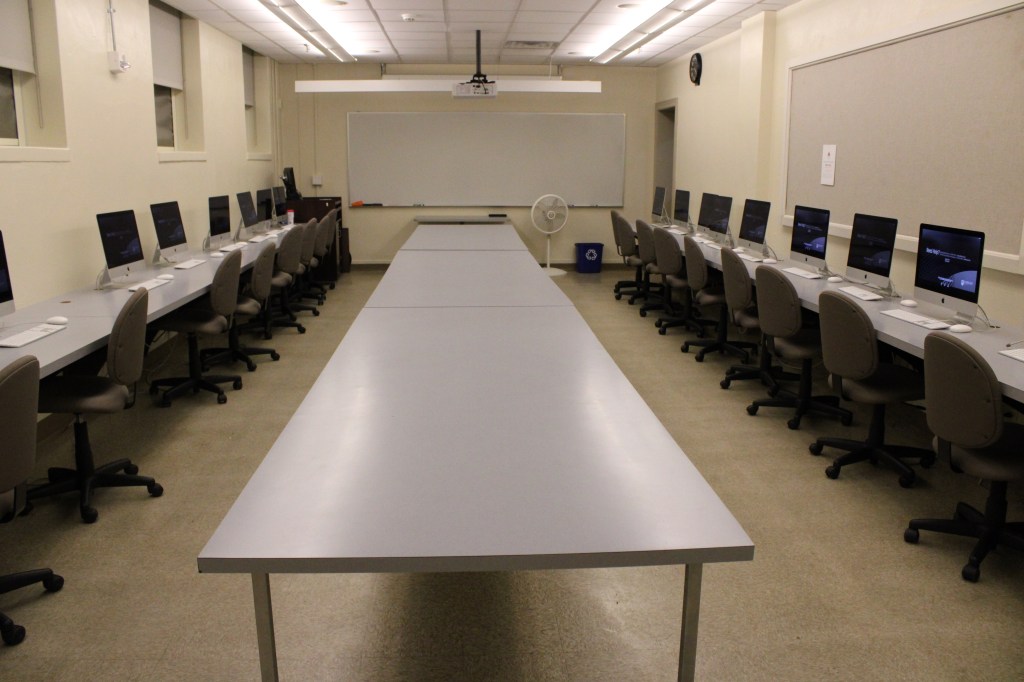
READING, Pa. — Albright College provides use of Mac labs and related software to students, however, issues ranging from access after hours and weekends to up-to-date software keep students discontent with the procedures put in place by public safety and the college’s IT department.
Many students, specifically those taking courses in fashion design, digital communications and fine arts, need the software that comes with Macs, which are used the most in classroom settings. According to the Digital Strategy and Infrastructure branch of the college’s website, the Mac labs on campus are in Teel Hall room B24 and Alumni Hall rooms 302 and 309. The computer programs on the Macs include Adobe Creative Cloud, design software typically used in the digital design courses; Final Cut Pro and iMovie, which are video editing programs; and GarageBand, an audio editing software. Accessing that software outside the classroom is where the issue lies with the students.
“Last year when I wanted to access a Mac lab, I got kicked out,” said Heidi Hernandez, a sophomore digital communications major. “I was told I couldn’t be there, even though it was for a class. At first, public safety wouldn’t even open the doors for me, but now they know that I’m a student who needs to use the labs.”
Hernandez explained that after these incidents she ended up purchasing the Adobe Creative Cloud so she wouldn’t have to worry about not being able to access the Mac labs when she needed them.
“Unfortunately, it’s a lot of money and I can’t cancel it because I need it,” she said. She has the student deal of Adobe Creative Cloud, paying $20 a month for the subscription in her first year, but now paying $30 each month.
Assistant Professor of Communications, Heidi Mau, who teaches digital communication design courses, explained that the college has been trying its best to accommodate the Mac use issues. “We have multiple Mac labs for students to work in around campus, and I think we do our best between the different departments to ensure that the same versions are in the labs that students might overlap use in,” she said. She explained that although the softwares don’t always match up, they are fairly good for the students. She thinks the software in Teel Hall matches up with the ones in Alumni Hall pretty well.
However, Mau does agree that sometimes the updates aren’t always the newest ones. “There are concerns with bringing new software onto old Adobe software,” she said. “A file worked on a 2019 version of InDesign will not open on the 2018 version. Some students run into that problem when opening their files on campus computers after working on them off campus.”
Tim Kiester, a client services specialist, explained that DSI doesn’t automatically upgrade the computers as new updates come out. They test them first, running the newest versions and assessing all the programs used on the Macs to make sure they all work. “Once they’ve all been verified, the updates are pushed out,” Kiester said.
However, sometimes an update gets delayed. “If there’s a big update to Photoshop but there’s a bunch of classes that are already using Photoshop, rather than push out the new version in the middle of what they’re learning already, we wait until the end of the semester to push out the update,” Kiester explained.
The machines themselves get upgraded every four years, Kiester said. All of the Macs on campus are replaced; the labs get new machines, as do any professors who teach from Mac computers.
“The software gets updated once, sometimes twice a year depending on when the updates come,” Kiester said. The updates are typically during the summer or winter when not that many students are on campus. For Adobe Creative Cloud, which many students use, the licenses are for the machine, Kiester explained. Machine-based licenses are more cost effective than user-based ones.
There are few Macs on campus that were not particularly a part of a computer lab, such as the two machines in the original library. “Anything that is not owned by an individual on campus is on the lab rotation,” Kiester explained. “It gets updated by us.”
However, Mau explained that these procedures sometimes aren’t enough. There are still issues. “Students have certainly requested and wanted access outside class time and their projects warrant it,” she said. “They need to have some kind of access after hours.”
Fashion student Alexa Melendez explained that it was a struggle for her sometimes, because “the labs are only open after classes are over, which, sometimes, isn’t until 10 p.m.”
Mau explained that the current system they have is sending course lists over to public safety who have a list of students who can get access to the labs after hours. The students then have to contact public safety to get in the labs. Public safety has to check the list and determine if they can let the students in.
In regards to the Mac use list, students are approved for the list and granted specific access to certain labs on campus, depending on what kind of classes they have during a semester, Mansaray explained. “What happens is that your professor would have your name on a roster for that class and he or she will send that over to us,” Mansaray said. “We then have the access list so we know who is supposed to be there for whatever amount of time.”
Mansaray also explained that someone from a student organization, typically the faculty advisor or leader of the club, would have to send a list to the director of public safety, Michael Gross, so he can then pass it on to the officers to let them know to give the students access.
Albright Public Safety is mainly concerned for the safety of the students and campus. Public Safety Student Officer and Dispatcher Sarah Mansaray explained that the buildings around campus are typically closed around 9 p.m. “The public safety officers typically like to lock the computer labs,” she explained. “Even though we have locks on the computers themselves, it’s better to be safe than sorry.”
Mau explained that even though public safety has been working well with them on this issue, there are still limitations. “There are constraints as to how late during the night you can be or what hours can be on the weekends and it’s an ongoing kind of need that students have,” she explained. “Still, we’re working towards trying to accommodate how we can give them potentially 24-hour access to labs but while also maintaining issues of safety within those labs, both in safety of equipment, but also in safety of students.”

 Deborah Afolabi