*All names have been changed for confidentiality purposes.
WALKERSVILLE, Md. — On March 18, Nigeria announced that entry into the country was restricted for travelers from countries that had more than 1,000 cases of the coronavirus, which includes the US. This news at the time came with the discovery of an additional five cases to the African Country’s original two. According to the New York Times, as of April 5, the US has 336,619 cases of the coronavirus, with 9,631 deaths, and Nigeria has 232 cases and five deaths.
The new influx of virus cases and travel bans have not only decreased revenue for airlines, but have continued to keep families separated. International students have been stranded on their college campuses, scared of being quarantined or stuck in unfamiliar places should they decide to return to their homelands. People who have traveled have been stuck abroad due to the new travel bans. Those planning on traveling, whether it be for spring break or other reasons, have had to scramble to change and/or cancel flights, not certain whether they will even get refunded for their tickets.
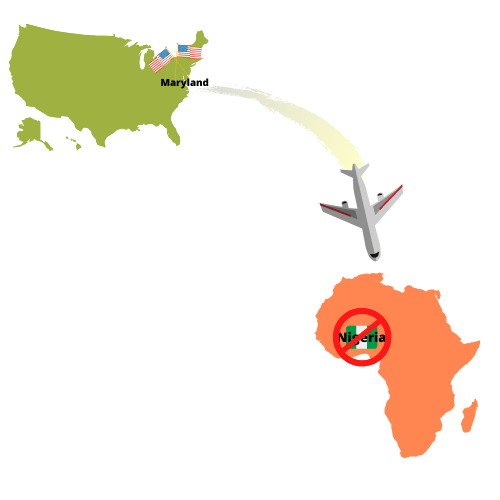
The travel ban against the US put a wrench in the travel plans of one family, Riley* and Lucy* and their eldest son Lucas*, who were planning on visiting their homeland in Nigeria from March 26 to April 7 for the burial ceremony of Lucy’s late mother.
The family does not travel back to Nigeria often due to cost; members of the family have visited Nigeria a total of five times since they moved to the US in 2003. Three out of the five times, it was because of a death in the family. This time was not any different, unfortunately, but it does make the news of the ban that much more impactful.
Their reactions to the news ranged from disappointment to guilt to even acceptance. Lucy expressed a feeling of guilt, since her mother’s burial ceremony had been postponed to April, even though she had passed in early December. “I felt bad,” she said. “They postponed the burial ceremony because of me. I was in school. I’m supposed to be there to see her before the burial. Now all this is happening.”
Lucas, 23, said that he was disappointed by the news. This trip was going to be his first time returning to Nigeria since the Afolabi’s had immigrated in 2003. “I’m the eldest of my three siblings,” he said. “I remember home a lot more than my younger siblings do. I want to see it with new eyes since it’s been so long and I’m older now.” He did explain that he has come to terms with the situation because this step is for everyone’s safety.
Riley, on the other hand, said that he had expected the news, although he had not anticipated the time frame. The day before the ban was announced, Nigeria had only had two confirmed cases, he explained. “The man was not Nigerian, and he had recovered,” Riley said. “We were still worried because Nigeria is overpopulated and passing the virus onto someone else was inevitable, but we had hope.”
Riley also said that he was a bit upset, because when the news of the ban came out, he was under the assumption that Nigerian citizens would be allowed to enter the country. With the exception of the youngest son, who was born in the US, all of the family have dual citizenship. However, even as a citizen, they would not be able to escape the measure the Nigerian government has adopted to stop the spread of the virus.
“Nigeria said that if you are a citizen and you come, you will be quarantined,” Riley said. “Quarantine in Nigeria is supervised. We don’t know what kind of facilities they might stick us in or what could happen to our belongings, and by the time we would get out of quarantine, we would’ve missed not just the funeral ceremony, but our flight home as well.”
Even before the news of the travel restrictions, the family had been seriously considering if they should still make the trip, explained Riley. This was due to changes in their work travel policies. While Lucas’s job at Best Buy might not be severely impacted, the same could not be said for Riley and Lucy, who both worked in retirement homes. All were asked to reconsider traveling by their places of work, but Best Buy’s requirements were not as extreme as that of assisted living. Lucas was only asked to quarantine himself if he traveled into any high risk areas or got sick.
Riley explained how everything had changed regarding his vacation time after the virus began to make a more prominent appearance. He had already done what needed to be done to request the time off, and had been approved for his trip since late December. “My work came up with the policy that if we travel, when we come back, we have to quarantine for three weeks, without pay,” he said. He explained that since his position was one that was required to be filed at all times, they would have to hire another person. “I wouldn’t have a job anymore and I’d have to reapply, only if they had another opening.”
For Lucy, she would have to be quarantined for 14 days without pay when she returned, only if she traveled through, or even just stopped over, Europe or any of the high risk countries. “I could use my paid time off, but I do not have enough to cover that time period,” she said. “In addition, my insurance, which is a benefit my job and a family plan, would not cover us should anything happen as a result.”
A main concern of the family was what would happen with their plane tickets due to the pandemic. According to Riley, they were constantly monitoring the situation in that regard. The first thing they noticed was prices. The airline they were flying with, Ethiopian Airlines, was the airline whose prices went up, while other airline tickets went down. “There was no risk traveling with them because they were not going through Europe at all,” Lucy said. “I think that’s why they didn’t decrease their prices.
Even so, the family still did not change their tickets. This was due to two reasons. The first reason was due to the arrival time in Africa. Nigeria is five hours ahead of Eastern Standard Time, which is the time zone in which the family currently resides. “Most airlines arrive in Nigeria in the evening,” Riley said. “Ethiopian Airlines is one of the few that arrive in Nigeria during midday and we wanted to arrive home around that time.”
The second reason they did not change airlines, and the main reason, is due to the tickets themselves. Their tickets were bought through an agent as promo tickets, which cannot be refunded or changed. Riley explained that they had not been worried about this at the time they bought the tickets because they were certain that they were going on the trip. “There was no sign that the ceremony was going to be canceled or postponed, so we were absolutely certain that we were going when we were going,” he said.
However, Ethiopian Airlines has been contacted, and the flight canceled, according to Riley. They will receive a fraction of what they paid for their tickets in a travel credit voucher. “The tickets cost $980 per person, and with the fraction we get back, we lose about $225 per person,” he said. “Ultimately we are losing $675 in total.”
The family is required to use the credit within one calendar year, which may prove difficult if the outbreak persists. They expressed that they simply don’t want the money or planning of the trip to go to waste.
Lucy expressed concern for her family back in Nigeria, since the virus has now put a lot of pressure on them. She explained that after the ban announcement, the state government in Nigeria hadn’t declared any state emergency, so her family was still planning on holding the ceremony, even though she couldn’t attend. However, she received a call from her brother on March 24 saying that they were having issues with the preparations. “Everyone, friends and family alike, started calling and saying that they were not coming,” she said. “Their venue was canceled. They are now running around and calling people to postpone the ceremony, again.”
The family plans on traveling to Nigeria once the pandemic dies down. Their main concerns lie with not knowing the future or how their work travel policies might change as a result of the coronavirus. “We can’t say that we are going to travel in the summer or even December because we don’t know how this situation will play out right now,” Riley said. “Every issue of traveling now has to be based on when this virus subsides.”

 Deborah Afolabi