By Merlinda Hilliard and Deborah Afolabi
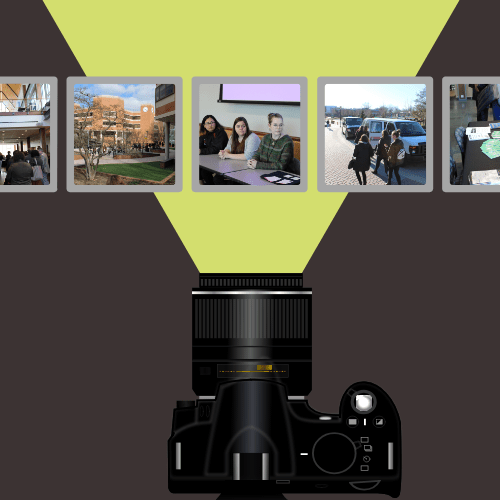
A picture is worth a thousand words. It’s true. Photos not only provide readers with a visual of what the text is saying, but gives you a space to write your own story based on the image. Therefore, as a journalist (and blogger), you must make sure you pick photos that tell more of a story than you can write yourself.
Pick photos that not only describe what you wrote perfectly, but can also add to your overlying message. Action shots are good, but make sure you take into account your environment. The setting can tell as much of a story as the people in the shot.
Write captions that tell the story of the photo. What are things the readers can’t see in the image? Give context. The key rule of “show, not tell” also applies to photo captions. The textbook, The Elements of Blogging, provides six guidelines to writing captions:
- Explain the image, don’t repeat what the reader sees.
- Explain details an image adds to the story.
- Add information the photo does not give.
- Use present tense.
- Avoid the obvious.
- Be brief.
Photo essays are a great way to tell a story, without much writing to it. They are meant to tell the audience a story about a person, place, thing, or event. When writing a photo essay, depending on what it’s on, chronology is very important. You’re telling a story, so you want to make sure the story makes sense. The order in which you place your photos will affect how your readers understand the story. Your captions should help progress the story with their descriptions of the photo. Everything in a photo essay, from the photos to your captions should help to move the story along, in addition to providing the message of the story.
Two great photo essays are A Segregation Story by Gordon Parks and Quiet Places by Mitch Epstein.
Parks’ essay features photos depicting the American South in the 1950s. His photos all feature people in it, but his use of the environment and the types of poses and situations captured really help tell the story of the segregation in the American South during that time period. The only issue that can be seen with Parks essay is that he doesn’t really use captions as descriptors. While some of his captions display a title that could tell what’s happening in the photo and the context for it, others are simply labeled “Untitled,” which doesn’t let the audience know what is going on.
Epstein’s essay displays the spaces of notable people after they died, just how they left it. His photos do not use people as subjects, but everyday materials and items. His photos are completely environment-based; no actions, but plenty to keep the mind and eyes occupied. There is enough in his angles, and types of shots that can still tell the story of the person who used that space. In addition, his captions, though long, give a lot of context, sharing stories in of themselves.
Discussion Questions:
- Take a look at Parks’ and Epstein’s photo essays, using the links above. What was good about their photos and captions? What do you think could be improved?
- What have you seen in other photo essays that have been effective to the storytelling process?
- How can you make your photo essays effective in telling a story? What messages can be derived from them?

 Deborah Afolabi
3. I think that a photo essay becomes effective when it is given the proper context. In my story I talk about how the virus pandemic has effected a local flea market, and I pair photos of the vacant lot with the emotional effect that the place had on me. Some images are poignant enough to tell their own story, but in this case I needed to provide context for images that do not have en emotional impact on their own.
LikeLike
3. I think that a photo essay becomes effective when it is given the proper context. In my story I talk about how the virus pandemic has effected a local flea market, and I pair photos of the vacant lot with the emotional effect that the place had on me. Some images are poignant enough to tell their own story, but in this case I needed to provide context for images that do not have en emotional impact on their own.
LikeLike
I think photo essays are effective when the topic they are focused on is the right one. They are usually only interesting if they can tell a story without words and some stories simply do not work for that. All of the photos must be interesting in their own right but also must relate back to the main topic.
LikeLike